
Manual SEO is a staffing problem disguised as a strategy problem. A solo founder or lean marketing team can’t consistently produce keyword research, content briefs, optimized drafts, technical audits, rank monitoring, and content decay fixes at the volume required to compound organic traffic. There aren’t enough hours.
Autonomous SEO agents change that equation. Not by replacing strategic thinking — but by replacing the 15–20 hours per week of mechanical execution that eats the time strategic thinking should occupy. BCG research puts the time savings at 25–40% reduction in low-value work for teams running AI-powered content workflows. Practitioners report getting from keyword idea to published, monitored article in a fraction of the time a manual workflow requires.
While automating the content operations for my digital storefronts like Techgng and SharifExpress, I’ve tested these tools extensively to see which ones actually eliminate manual work. The finding that most listicles miss: the difference between an “AI SEO tool” and a genuine autonomous SEO agent is not marketing language — it’s the number of pipeline stages the tool handles without a human handoff. A tool that writes a draft is not an agent. A tool that researches keywords, writes the draft, scores it against SERP competitors, publishes to your CMS, monitors rankings, and flags content decay is an agent.
This article ranks tools by that standard.
Table of Contents
The 6-Stage SEO Pipeline — The Only Framework That Matters
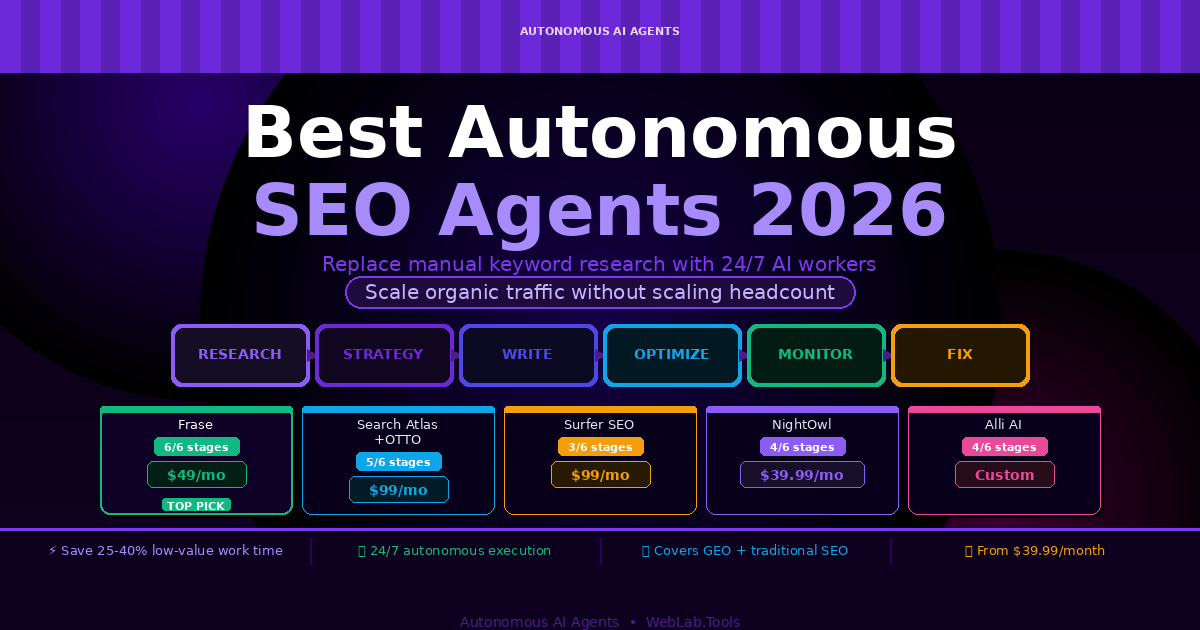
Every piece of organic content moves through six stages. The more stages a tool covers autonomously, the closer it is to a true AI SEO agent.
Stage 1 — Research: Keyword discovery, SERP analysis, competitor content gap identification, intent mapping.
Stage 2 — Strategy: Topic clustering, content calendar planning, topical authority gap analysis, priority scoring.
Stage 3 — Write: Draft creation, entity inclusion, heading structure, word count calibration against SERP benchmarks.
Stage 4 — Optimize: Real-time content scoring, NLP entity gaps, on-page technical optimization, GEO structuring for AI citation.
Stage 5 — Monitor: Rank tracking, traffic change alerts, content decay detection, AI visibility tracking across ChatGPT/Perplexity.
Stage 6 — Fix: Autonomous content updates, technical SEO remediation, broken link repair, schema implementation.
Tools that cover 1–2 stages are AI writing tools. Tools that cover 3–4 stages are AI-assisted SEO tools. Tools that cover 5–6 stages are autonomous SEO agents. Keep that framework in mind as you read every vendor claim in this category.
Quick Comparison — Best Autonomous SEO Agents 2026
| Tool | Pipeline Stages | Starting Price | GEO Tracking | CMS Publish | Best For |
|---|---|---|---|---|---|
| Frase | 6/6 | $49/month | Yes | Yes (via MCP) | Full-pipeline content teams |
| Search Atlas + OTTO | 5/6 | $99/month | Limited | Yes | All-in-one SEO + automation |
| Surfer SEO | 3/6 | $99/month | Add-on ($95/mo) | No | Content optimization specialists |
| NightOwl | 4/6 | $39.99/month | No | WordPress only | Budget-first solo SEOs |
| Semrush AI Toolkit | 3/6 | $139.95/month | Yes (One plan) | No | Research-heavy teams |
| Alli AI | 4/6 | Contact for pricing | No | Yes (technical) | Technical SEO automation |
All prices as of May 2026 — confirm at each tool’s official pricing page before purchasing.
1. Frase — Best Full-Pipeline Autonomous SEO Agent
Frase is the only tool on this list that covers all six stages of the SEO content pipeline without requiring a separate tool for any stage. Research, strategy, writing, optimization, monitoring, and content recovery — all connected through a single workflow, including a native MCP (Model Context Protocol) integration that allows your AI agent to move from keyword research to published, monitored article without a single manual handoff.
The MCP integration is the capability that separates Frase from every competitor in the content-layer category. Using Claude Code, Cursor, or Windsurf as your AI coding environment, you can prompt: “Research the keyword ‘B2B content syndication’, analyze the SERP, identify content gaps, create a brief, write a draft, and score it against top competitors.” The agent executes every step using Frase’s live SEO data, not a static training dataset.
Content monitoring is the stage most tools either omit or charge separately for. Frase’s decay detection identifies when a page’s rankings begin dropping before the traffic loss becomes severe, and generates the specific content updates needed to recover — not a generic recommendation to “add more content,” but entity-by-entity and section-by-section optimization guidance.
The GEO layer is genuinely integrated rather than bolted on. Content scoring checks for GEO readiness alongside traditional SEO optimization — factual density, citation structure, entity clarity, and answer-format compliance — the elements that determine whether an LLM is likely to extract and cite your content.
What most Frase reviews miss: The $49/month Starter plan includes the full MCP access and all six pipeline stages — not a downgraded version. Most tools in this category gate their best capabilities behind $200+ tiers. Frase doesn’t. For a lean content team or solo SEO trying to run an autonomous pipeline at the lowest possible cost, $49/month with full agent capability is anomalous value in this market.
The honest limitation: Frase’s keyword research database is smaller than Semrush or Ahrefs. For deep competitive backlink intelligence or PPC research, you’ll still need a dedicated research tool. Frase wins the content production and optimization layer comprehensively — it doesn’t attempt to be a complete SEO data platform.
Pricing as of May 2026 — confirm at frase.io/pricing:
- Starter: $49/month — all 6 pipeline stages, full MCP access, no feature gating
- Growth: $114/month — team features, higher document volume, priority support
- Enterprise: Custom pricing — dedicated support, custom integrations
Best for: Content teams and solo SEOs who want a genuine end-to-end autonomous workflow at an accessible price point. The best single-tool answer for replacing a manual research → write → optimize → monitor → fix pipeline.
Skip if: Backlink analysis and deep competitive research are your primary SEO activities. Frase’s data layer isn’t built for those workflows — pair it with Ahrefs for the research layer and use Frase for everything downstream.
2. Search Atlas + OTTO SEO — Best All-in-One Platform With Automation
Search Atlas is the tool that most frequently surprises people who evaluate it. It covers keyword research, rank tracking, content optimization, backlink analysis, and technical SEO in one platform — at a starting price of $99/month that undercuts Semrush and Ahrefs on a feature-per-dollar basis. The OTTO SEO automation layer is what earns it a place on this list as an autonomous agent rather than a traditional SEO suite.
OTTO SEO is an autonomous technical and on-page SEO agent. Connect it to your site and it continuously crawls for issues — broken links, missing schema, thin content, duplicate meta tags, internal linking gaps — and executes fixes directly. Not recommendations. Actual fixes pushed to your site without you clicking through a remediation checklist. Teams that previously spent 8–10 hours per month on technical SEO maintenance report reducing that to under an hour of oversight after OTTO deployment.
The Content Genius AI writing tool integrates with the keyword research and rank tracking layers, meaning content briefs are generated from live rank data rather than static keyword inputs. When you write a new article targeting a cluster of keywords, Content Genius knows what your existing content covers, what your competitors rank for, and what gaps exist across your topical map.
What most Search Atlas reviews miss: Teams replacing Ahrefs plus Surfer SEO plus Jasper with Search Atlas typically save $200–$400 per month while gaining OTTO’s technical automation that none of those individual tools provide. The value comparison isn’t Search Atlas vs one tool — it’s Search Atlas vs your current fragmented stack.
The honest limitation: Search Atlas’s AI visibility and GEO tracking is limited compared to Semrush One’s dedicated toolkit. If tracking your brand’s presence inside ChatGPT and Perplexity is a primary requirement, Search Atlas needs supplementing. The backlink database also lags behind Ahrefs in depth, which matters for serious link-building campaigns.
Pricing as of May 2026 — confirm at searchatlas.com/pricing:
- Starter: $99/month — core SEO tools, OTTO SEO automation, Content Genius
- Growth: $199/month — expanded limits, team seats, agency features
- Pro: $399/month — highest limits, white-label, API access
- Enterprise: Custom pricing
Best for: Small to mid-size SEO teams and agencies that want to consolidate their tool stack, reduce monthly spend, and add autonomous technical SEO remediation without managing a separate agent platform.
Skip if: Deep backlink research is your core workflow, or AI visibility tracking across ChatGPT and Perplexity is a primary deliverable. Both require supplementary tools alongside Search Atlas at current capability levels.
3. Surfer SEO — Best for Content Optimization Specialists
Surfer SEO covers three of the six pipeline stages — writing, optimization, and partial monitoring — with the most polished execution in the content optimization category. The Content Editor’s real-time NLP scoring against live SERP data is the standard that every other content optimization tool is measured against. Writing inside the Surfer editor and watching the content score update as you add entities, adjust headings, and hit word count targets is genuinely the most actionable feedback loop available for on-page optimization.
Surfer AI generates complete articles from a keyword input, optimized against SERP data from the moment of drafting. The integration with Google Docs and WordPress means optimization happens in the environment where your team already works rather than requiring a platform switch. For a content team producing 20–40 articles per month, that integration reduces friction meaningfully.
The AI Tracker add-on at $95/month monitors brand visibility in AI responses — tracking how often your content is cited across AI platforms. At that add-on price, the cost of Surfer plus AI tracking ($99 + $95 = $194/month minimum) approaches Semrush One Starter pricing while covering fewer pipeline stages. That cost comparison matters when budgeting.
The honest limitation: Surfer is a content optimization tool that has added AI writing and limited monitoring. It does not autonomously publish, does not have technical SEO remediation, does not detect content decay and generate recovery plans, and does not have the MCP agent integration that allows multi-step autonomous workflows. Each Surfer AI article generation costs $29 on top of subscription pricing — at volume, that per-article fee compounds significantly.
Pricing as of May 2026 — confirm at surferseo.com/pricing:
- Essential: $99/month — 30 articles, Content Editor, Surfer AI included
- Scale: $219/month — 100 articles, team access, white-label
- Enterprise: Custom pricing
- AI Tracker (GEO monitoring): $95/month add-on, 25 prompts
Best for: Content writers and SEO specialists who want the highest-quality real-time optimization feedback available, and whose primary workflow is producing and optimizing individual articles rather than running a full autonomous pipeline.
Skip if: You need end-to-end automation that covers research through publishing and monitoring. Surfer’s strength is the optimization stage — it’s not a full autonomous agent and doesn’t pretend to be.
4. NightOwl — Best Budget Entry Point for Autonomous SEO
NightOwl is the autonomous SEO agent for teams that need meaningful automation at under $50/month — covering keyword research, technical audits, competitor tracking, rank monitoring, and AI-generated content. At $39.99/month on the Starter plan, it covers four of the six pipeline stages at a price point where most competitors offer no agent capability at all.
The 24/7 site scanning is the headline feature — NightOwl continuously crawls your site, monitors keyword performance, detects technical issues (missing H1s, broken links, crawl errors, duplicate pages), and surfaces prioritized recommendations without waiting for you to run a manual audit. For a solo founder or one-person content team, that continuous monitoring replaces the discipline of remembering to run monthly technical checks.
Keyword clustering groups related terms by intent, difficulty, and relevance automatically. Competitor tracking monitors up to 5 competitors and surfaces SERP pattern changes, ranking cannibalization risks, and content gaps — the research layer that typically requires a separate Ahrefs or Semrush subscription.
The honest limitation: NightOwl publishes directly to WordPress only — no Webflow, no Shopify, no headless CMS integration. If your site isn’t on WordPress, the CMS publishing automation is unavailable. GEO tracking and AI visibility monitoring are also absent at all price tiers — a meaningful gap for teams where AI search presence is a priority metric. The Starter plan’s 200 keyword credits and 40 AI content pieces per month create real volume ceilings for teams publishing at scale.
Pricing as of May 2026 — confirm at nightowl.ai or the official NightOwl pricing page:
- Starter: $39.99/month (or $31.99/month annual) — 200 keyword credits, 40 AI content pieces/month
- Pro: $79.99/month (or $63.99/month annual) — 600 keyword credits, 120 AI content pieces/month
- Enterprise: $349.99/month (or $279.99/month annual) — 2,500 credits, 500 content pieces, agency scale
Best for: Solo SEOs, small business owners, and content creators who want autonomous site monitoring, keyword research, and WordPress publishing at the lowest price in the category.
Skip if: Your site is not on WordPress, you need GEO and AI visibility tracking, or your content volume exceeds 40 pieces per month on the entry plan.
5. Alli AI — Best for Autonomous Technical SEO at Scale
Alli AI occupies a specific and valuable niche: autonomous technical SEO remediation across large sites without developer involvement. It deploys schema markup, fixes internal linking issues, optimizes title tags and meta descriptions, and implements on-page changes directly via a lightweight script — without requiring your development team to touch anything.
For an e-commerce site with 10,000+ product pages, a publisher with 5,000+ articles, or an agency managing 20+ client sites, the manual overhead of technical SEO maintenance is prohibitive. Alli AI’s autonomous deployment handles that maintenance continuously — changes deploy in real time as the agent identifies and fixes issues, tracked in a dashboard that shows before/after states for every modification.
The site speed optimization module runs autonomous improvements to Core Web Vitals scores — a ranking factor that remains material in 2026 and that most teams address reactively rather than proactively.
The honest limitation: Alli AI is a technical SEO specialist, not a content platform. It covers stages 4 and 6 of the pipeline well — optimization and fixing. It has no content research, writing, or strategy capability. Teams that need both content creation and technical automation will use Alli AI alongside a content-layer tool like Frase or Search Atlas. Pricing is not publicly listed — confirmed at $99/month entry from multiple independent sources but verify directly before budgeting.
Pricing as of May 2026 — confirm directly at alliai.com/pricing:
- Estimated from $99/month based on multiple independent sources — [confirm directly before purchasing]
- Enterprise and agency plans available — custom pricing
Best for: E-commerce sites, large publishers, and agencies that need autonomous technical SEO deployment across high page-count sites without developer dependencies.
Skip if: Content creation and research automation are your primary requirement. Alli AI is a technical layer tool that pairs with a content agent, not a replacement for one.
6. Semrush AI Toolkit — Best Research Layer for Teams That Already Use Semrush
Semrush’s AI capabilities across its platform cover research and monitoring competently but do not constitute a full autonomous agent workflow. The Keyword Magic Tool, competitive intelligence, and site audit features are the best pure research infrastructure in the category. The AI Visibility Toolkit within Semrush One adds daily prompt-level tracking across ChatGPT, Google AI Mode, Gemini, and Perplexity — the most accurate AI search monitoring available in a mainstream SEO platform.
What’s missing from an autonomous agent standpoint is the execution layer. Semrush researches and monitors effectively. It does not autonomously write content, publish to your CMS, or deploy technical fixes. You take the data and act on it manually — or pipe it through a separate workflow automation tool. The Semrush MCP integration allows connecting Semrush data directly to Claude and other LLMs for automated analysis and strategy generation, which partially addresses this gap, but it requires setup and technical comfort.
For teams already paying for Semrush as their primary SEO platform, the AI Toolkit within Semrush One is the logical upgrade rather than a new tool purchase. For teams evaluating from scratch specifically for autonomous workflow automation, the cost-to-automation-depth ratio favors Frase or Search Atlas over Semrush.
Pricing as of May 2026 — confirm at semrush.com/prices:
- Semrush Pro: $139.95/month — core SEO, no AI visibility
- Semrush One Starter: $199/month — SEO + AI Visibility Toolkit combined
- Semrush One Pro+: $299/month — expanded AI tracking limits
- Semrush One Advanced: $549/month — full depth, highest limits
Best for: Teams already using Semrush for research and competitive intelligence who want to add AI visibility tracking without adopting a new platform.
Skip if: You’re evaluating specifically for autonomous content workflow automation. Semrush’s strength is data depth — not autonomous execution across the full pipeline.
The Stack That Actually Works at Every Budget Level
Under $50/month — the solo founder stack: NightOwl at $39.99/month handles keyword research, technical auditing, competitor monitoring, and WordPress publishing autonomously. Pair with Google Search Console (free) for ranking data. This is a functional autonomous stack for a single-site operation at a price point most people spend on SaaS tools they barely use.
$50–$150/month — the content team stack: Frase at $49/month for the full content pipeline — research through monitoring via MCP — plus Ahrefs Webmaster Tools (free) for backlink monitoring on your own domain. Total cost under $50/month with genuine end-to-end workflow automation for content production.
$150–$400/month — the growth team stack: Search Atlas at $99–$199/month consolidates keyword research, rank tracking, content optimization, and OTTO’s autonomous technical SEO. Add Semrush One Starter at $199/month if AI visibility tracking across ChatGPT and Perplexity is a reporting requirement. Run them as separate layers — Search Atlas for execution, Semrush for research and AI monitoring.
Agency scale ($400+/month): The full stack: Ahrefs Standard for backlink research and competitive intelligence, Frase for autonomous content pipeline, Alli AI for technical deployment at scale, Semrush One for AI visibility reporting. Each tool handles the pipeline stages it does best. Total cost is higher but replaces what previously required a 2–3 person SEO team for execution.
For teams building content at scale alongside their autonomous SEO workflow, the Programmatic SEO Software guide covers how to generate thousands of landing pages programmatically — a complementary strategy to the single-article autonomous workflow these agents handle. And for the outbound component that supports link building campaigns, see the AI Sales Agents for Small Business article.
FAQ
What is an autonomous SEO agent and how is it different from an AI SEO tool?
An AI SEO tool is reactive — you give it a prompt and it returns output for one task. You still handle every other step manually. An autonomous SEO agent is goal-oriented — you give it an objective and it plans and executes across multiple pipeline stages without waiting for your input between steps. The practical difference: an AI writing tool saves you 30 minutes per article. An autonomous SEO agent saves you 15–20 hours per week of mechanical workflow execution.
Can autonomous SEO agents replace a human SEO specialist?
They replace the execution of routine SEO tasks — not the strategic thinking behind them. An autonomous agent can continuously crawl a site, identify ranking opportunities, write and optimize content, publish it, and flag when it starts losing ground. What it cannot do is understand your brand’s competitive positioning, identify content angles that resonate with a specific audience, or make judgment calls about which opportunities align with business priorities. The most effective setup in 2026 is an agent handling execution while a human focuses on strategy — a combination that BCG data suggests reduces low-value work time by 25–40%.
Which autonomous SEO agent is best for a small business in 2026?
Frase at $49/month is the best value for a small business that primarily needs a content workflow agent — covering all six pipeline stages at the lowest price in the category. NightOwl at $39.99/month is the right choice for a single-site operator who wants autonomous technical monitoring and WordPress publishing without content creation depth. Search Atlas at $99/month is the best option for teams wanting an all-in-one platform that consolidates keyword research, rank tracking, content tools, and OTTO’s autonomous technical SEO in one subscription.
Do these tools optimize for GEO (Generative Engine Optimization) as well as traditional SEO?
Some do. Frase integrates GEO scoring directly into its content optimization workflow — checking factual density, entity clarity, citation structure, and answer-format compliance alongside traditional SEO metrics. Semrush One provides the most comprehensive AI visibility tracking across ChatGPT, Perplexity, and Google AI platforms. Surfer’s AI Tracker add-on at $95/month adds GEO monitoring. NightOwl and Alli AI do not currently address GEO. For teams where AI search visibility is a primary metric, Frase for content creation plus Semrush One for AI tracking is the most complete stack available in 2026.
How long does it take for an autonomous SEO agent to show results?
Initial setup and calibration typically takes 1–2 weeks. Most platforms show the first measurable ranking improvements within 30–60 days of autonomous optimization deployment. Teams that were previously publishing inconsistently see the fastest gains — the agent’s consistency in publishing and optimization compounds quickly when the baseline is irregular manual output. For technical SEO remediation specifically, Alli AI and OTTO SEO often show crawl improvement signals within 2–4 weeks of deployment.

