
This comparison used to be simple. Ahrefs for backlinks. Semrush for everything else. That framing still holds in 2026 — but the question that now matters most for content and SEO teams is one neither tool was designed to answer three years ago: which platform tracks your brand’s visibility inside ChatGPT, Perplexity, and Google AI Mode?
GEO — Generative Engine Optimization — is no longer a future concern. AI search is actively pulling traffic from traditional organic results in 2026, and teams that cannot measure their AI visibility cannot improve it. Both Ahrefs and Semrush have shipped AI tracking features in the past 12 months. Those features are meaningfully different, and in one documented test, the accuracy gap is significant enough to affect real decisions.
While managing SEO and content strategy for my own digital storefronts like Techgng and the SharifExpress brand, I’ve used both platforms extensively. This article covers what both tools actually do in 2026, where the data holds up, and where it doesn’t — including the AI tracking accuracy numbers that most comparison articles haven’t picked up yet.
Table of Contents
Two Things That Changed in 2026 Before You Read Anything Else
Semrush is now an Adobe company. The acquisition closed in 2025. Semrush continues operating normally under its own brand in the near term. But Adobe’s historical pattern with acquisitions — Magento, Marketo — is to restructure pricing 12–24 months post-acquisition. If you’re signing a multi-year contract with Semrush right now, that context belongs in the decision.
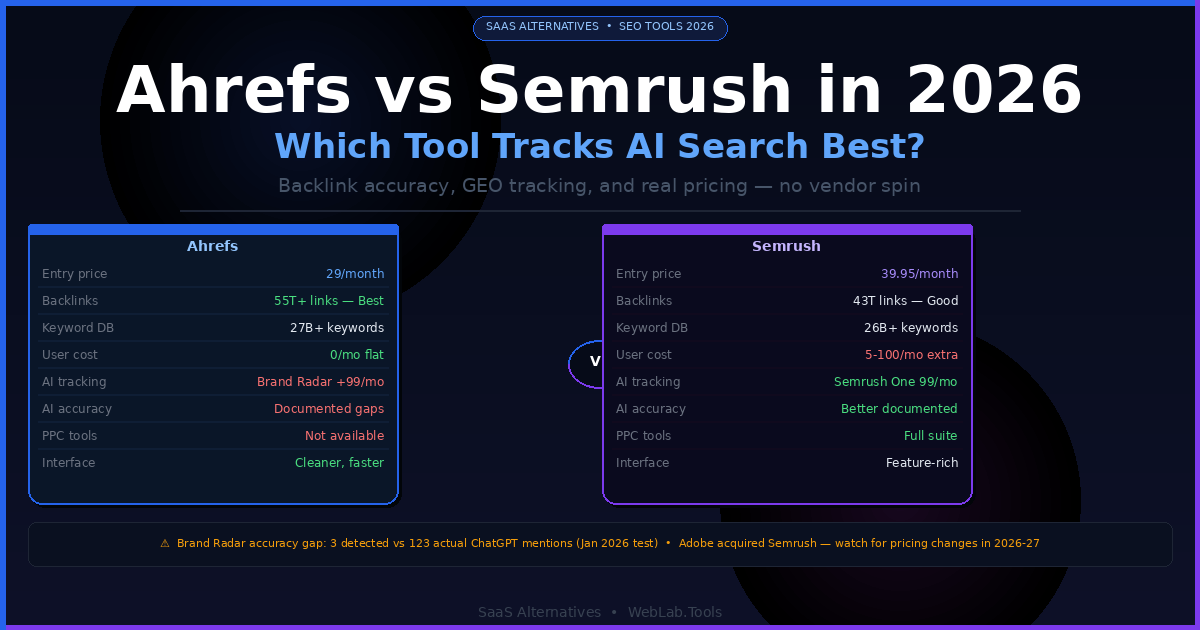
Ahrefs Brand Radar failed an accuracy test in January 2026. An independent test by TryAnalyze.ai ran the same brand audit through Brand Radar and through direct manual searches of ChatGPT and Perplexity. The results: Brand Radar detected 3 ChatGPT mentions where manual search found 123. It detected 6 Perplexity mentions where manual search found 212. That is not a rounding error — it’s an order-of-magnitude gap that makes Brand Radar unreliable as a primary AI visibility tracking tool at current levels. This is a critical data point for any team evaluating these platforms specifically for GEO use cases.
Both of these facts matter for the verdict. Neither is widely covered in current comparison articles.
Quick Comparison — Ahrefs vs Semrush 2026
| Ahrefs | Semrush | |
|---|---|---|
| Entry price | $129/month (Lite) | $139.95/month (Pro) |
| Backlink database | 55 trillion+ links | 43 trillion links |
| Keyword database | 27B+ keywords | 26B+ keywords (USA: 3.7B) |
| AI search tracking | Brand Radar ($199/mo add-on) | AI SEO Toolkit (Semrush One from $199/mo) |
| AI platforms covered | ChatGPT, Perplexity, AI Overviews, Gemini, Copilot | ChatGPT, Google AI Overviews, AI Mode, Gemini, Perplexity |
| Tracking cadence | Brand-level, not daily per prompt | Daily prompt-level tracking |
| AI tracking accuracy | Documented gaps (Jan 2026 test) | Stronger on prompt-level, still imperfect |
| PPC tools | No | Yes |
| Content marketing tools | Limited | Full suite (Guru+) |
| Additional user cost | $50/month flat per user | $45–$100/month per user |
| Adobe acquisition risk | No | Yes — pricing changes possible in 12–24 months |
Pricing as of May 2026 — confirm at ahrefs.com/pricing and semrush.com/prices before purchasing.
Pricing — The Real Cost at Every Meaningful Tier
Both tools look comparably priced at a glance. The actual costs diverge when you add users and features.
Ahrefs pricing as of May 2026 — confirm at ahrefs.com/pricing:
- Starter: $29/month — 100 credits, light usage only, not a professional workflow tool
- Lite: $129/month (monthly) / $108/month (annual) — core tools, 500 keywords tracked, 1 user
- Standard: $249/month (monthly) / $208/month (annual) — 1,500 keywords, 20 projects, unlimited report rows
- Advanced: $449/month — 5,000 keywords, 50 projects, advanced features
- Enterprise: $1,499/month — unlimited, API, custom reporting
- Additional users: $50/month flat per user on all plans
- Brand Radar (AI tracking): $199/month add-on on any paid plan
Semrush pricing as of May 2026 — confirm at semrush.com/prices:
- Pro: $139.95/month — 5 projects, 500 tracked keywords, 1 user. Core SEO only, no content tools
- Guru: $249.95/month — 15 projects, 1,500 keywords, Content Marketing Toolkit, historical data
- Business: $499.95/month — 40 projects, 5,000 keywords, API access, Share of Voice
- Semrush One Starter: $199/month — traditional SEO + AI Visibility Toolkit combined
- Semrush One Pro+: $299/month — expanded AI tracking limits
- Semrush One Advanced: $549/month — highest limits, full AI tracking depth
- Additional users: $45/month (Pro), $80/month (Guru), $100/month (Business)
The cost calculation most people miss: Semrush’s plans are single-user by default. A 2-person team on Semrush Guru pays $249.95 + $80 = $329.95/month. A 2-person team on Ahrefs Standard pays $249 + $50 = $299/month. Ahrefs is cheaper for multi-user teams on comparable plans. At 3 users, the gap widens further.
For AI tracking specifically: Adding Ahrefs Brand Radar to an Ahrefs Lite subscription costs $129 + $199 = $328/month. Semrush One Starter at $199/month includes both traditional SEO features and the AI Visibility Toolkit. On pure price-for-AI-tracking, Semrush One undercuts the Ahrefs equivalent by $129/month — while also delivering better documented accuracy.
Backlink Data — Ahrefs Wins, and It’s Not Close
This is the one category where the verdict has been consistent for years and hasn’t changed in 2026. Ahrefs has the more accurate, more comprehensive backlink database.
Ahrefs crawls the web more frequently and indexes more referring domains than Semrush. The community consensus — including G2 reviewers, SEO practitioners on Reddit, and independent audits — consistently rates Ahrefs’ backlink data as more reliable for link prospecting, competitor analysis, and toxic link identification.
The practical difference shows up in link-building workflows. When running a backlink gap analysis — finding sites that link to competitors but not your domain — Ahrefs surfaces more opportunities with less noise. Semrush’s backlink tool is functional and the toxic score metric is useful for disavow workflows, but agencies that do link-building as a primary service almost universally prefer Ahrefs as the research tool.
One honest note: Semrush’s backlink database covers 43 trillion links across 390 million referring domains — not a small dataset. The difference isn’t Semrush being bad at backlinks. It’s Ahrefs being categorically better at them. For teams whose primary use case is backlink research, that distinction justifies the tool choice immediately.
Keyword Research — Semrush Has More Data, Ahrefs Has Better UX
Semrush’s Keyword Magic Tool is the largest keyword database in the category. 26 billion+ keywords globally, with 3.7 billion for the US market alone. For content teams building topic clusters and mapping search intent across a broad content strategy, that database depth produces more keyword variations per research session.
The Semrush Keyword Overview tool adds layers that Ahrefs doesn’t have at a comparable level — Personal Keyword Difficulty (PKD), which adjusts difficulty scores based on your specific domain’s authority rather than a universal score. Topical Authority metrics that show how Google perceives your domain on specific subject areas. These are genuinely useful for prioritizing which keywords a specific site can realistically rank for, not just which keywords are theoretically accessible.
Ahrefs’ Keywords Explorer is cleaner and faster. The interface is less cluttered, the data loads quickly, and the SERP overview for any keyword shows clickthrough distribution across organic, AI Overview, and paid results — which is increasingly important context for keyword prioritization in 2026. When a keyword’s traffic is being absorbed by AI Overviews, ranking position 3 delivers less traffic than position 3 did two years ago. Ahrefs visualizes that shift. Semrush does too, but Ahrefs’ interface surfaces it more immediately.
For standard keyword research — finding what to write, understanding difficulty, mapping competitors’ content gaps — both tools perform the core function competently. Semrush wins on database volume. Ahrefs wins on interface speed and workflow clarity. The difference is meaningful for power users but not the deciding factor for most teams.
AI Search Tracking — The Category That Changes Everything in 2026
This is where the comparison gets specific and where most 2026 articles have gotten it wrong by treating both tools as equivalent GEO trackers. They are not.
Semrush AI SEO Toolkit (via Semrush One)
Semrush tracks brand and keyword visibility across ChatGPT, Google AI Overviews, Google AI Mode, Gemini, and Perplexity. The tracking is prompt-level — you define a set of queries, and Semrush monitors which brands appear in the AI responses to those queries on a daily cadence. You can track up to 50 custom prompts per day on the Starter tier. The data integrates directly with traditional SEO metrics — you can correlate AI visibility changes with organic ranking movements and backlink growth in the same dashboard.
The Semrush MCP (Model Context Protocol) integration allows teams to connect Semrush data directly into Claude and other AI workflows — automating keyword research, content strategy generation, and site audit processes through natural language prompts rather than manual dashboard navigation. That capability has no equivalent in Ahrefs currently.
Ahrefs Brand Radar
Brand Radar tracks share of voice across AI platforms using a database that Ahrefs reports at 271 million prompts covering ChatGPT, Perplexity, AI Overviews, Gemini, and Copilot. The tool focuses on brand-level tracking — how often your brand appears in AI responses relative to competitors — rather than prompt-by-prompt keyword-level monitoring.
The platform coverage is actually broader than Semrush — Copilot is included where Semrush’s coverage is thinner on that platform. YouTube and Reddit visibility tracking were added in 2025, providing an entity-level view of brand presence that extends beyond pure AI search.
The accuracy problem that cannot be ignored
The January 2026 TryAnalyze.ai independent test is the most important data point in this comparison for anyone evaluating AI tracking specifically. Running identical brand queries manually through ChatGPT and Perplexity, then comparing those results to Brand Radar’s reported numbers, the gap was severe: 3 detected vs 123 actual on ChatGPT, 6 detected vs 212 actual on Perplexity.
Ahrefs acknowledged that Brand Radar uses a different methodology — real PAA (People Also Ask) data plus its keyword index rather than synthetic prompt testing — which explains the divergence. Whether that methodology is more representative of actual user behavior is a legitimate debate. What it means practically: if you’re using Brand Radar to report AI visibility to a client or stakeholder and the numbers show low brand presence, you may be dramatically undercounting actual presence.
Semrush’s AI tracking accuracy is also imperfect — no tool has solved this perfectly in 2026. But Semrush’s prompt-based daily tracking methodology produces numbers that correlate more closely with manual verification in independent assessments.
Technical SEO Auditing — Close, With Different Strengths
Both tools run comprehensive site audits. Ahrefs crawls 170+ technical parameters. Semrush audits 140+ parameters but organizes them into thematic reports — crawlability, HTTPS implementation, Core Web Vitals, internal linking — that make prioritization faster for teams without dedicated technical SEO specialists.
Ahrefs’ site audit is faster on very large sites (100,000+ pages) and presents data in a cleaner visual format. For technical SEO teams who know what they’re looking for, the Ahrefs audit is a faster research tool. For content or marketing teams who need actionable recommendations without deep technical SEO knowledge, Semrush’s organized thematic structure reduces time-to-action.
The honest summary: if your site has under 50,000 pages and your team isn’t exclusively technical SEO practitioners, both tools audit adequately. The difference is UX, not coverage.
What Semrush Has That Ahrefs Doesn’t
Semrush is a marketing platform that does SEO. Ahrefs is an SEO platform. That distinction becomes material in three specific areas:
PPC research. Semrush provides competitor ad copy, keyword bidding data, Google Ads intelligence, and historical PPC performance. Ahrefs has no equivalent. For teams where paid and organic search inform each other — which is most growth teams — that data lives in Semrush and nowhere else without a separate Spyfu or SimilarWeb subscription.
Content Marketing Toolkit. Available on Guru and above, this includes Topic Research (content cluster mapping from SERP data), SEO Writing Assistant (real-time content scoring against top-ranking pages), and SEO Content Templates. Ahrefs’ content tools are lighter — a content gap tool and basic content explorer, not a writing workflow suite.
Local SEO management. Semrush’s local listing tool manages business listings across 150+ directories simultaneously. Ahrefs has no local SEO infrastructure. For agencies managing local clients, that gap means maintaining a separate subscription for local tools on top of Ahrefs.
What Ahrefs Has That Semrush Doesn’t
Ahrefs Webmaster Tools. Free verified access to Site Explorer and Site Audit for your own domains — with no credit system or report limits. For a startup that owns a single site and needs basic backlink monitoring and technical audit capability without a paid subscription, this is genuinely useful. Semrush has no equivalent free tier with this level of depth.
Cleaner, faster interface. Among SEO practitioners who use both tools, Ahrefs consistently receives higher marks on UX. Navigation is more intuitive, report loading is faster, and the interface makes fewer assumptions about what you need. For teams spending hours per day in their SEO tool, that friction difference has real productivity value.
Better multi-user cost at scale. The $50/month flat additional user fee is predictable and cheaper than Semrush’s tiered user pricing on most plans. A 5-person SEO team costs significantly less in user fees on Ahrefs than on a comparable Semrush plan.
Who Should Choose Ahrefs
Choose Ahrefs if:
- Backlink analysis and competitive link intelligence are your primary SEO activities
- Your team has multiple users — the $50/month flat user fee saves meaningful money at 3+ seats
- You want a clean, fast interface that technical SEO practitioners prefer for daily workflow
- You need Ahrefs Webmaster Tools’ free offering for basic site monitoring without a paid subscription
- Your SEO strategy doesn’t require PPC data, local listing management, or a content writing assistant
Skip Ahrefs if:
- AI search visibility tracking is a primary requirement — Brand Radar’s documented accuracy gaps make it unreliable as a primary GEO tool at current levels
- Your team needs PPC competitive intelligence alongside SEO
- You’re evaluating based on AI tracking cost efficiency — Semrush One beats the Ahrefs + Brand Radar combination on both price and documented accuracy
Who Should Choose Semrush
Choose Semrush if:
- AI search visibility tracking is a strategic priority and you need the most accurate available tool in 2026
- Your team uses paid search alongside organic, and having PPC data in the same platform eliminates a separate subscription
- You need a content marketing workflow — Topic Research, SEO Writing Assistant, content templates — integrated with your keyword and ranking data
- You manage local SEO clients and need listing management without a separate tool
- You want the Semrush MCP integration to connect SEO workflows directly into AI tools like Claude
Skip Semrush if:
- You’re a solo practitioner doing primarily backlink-focused SEO — Ahrefs Lite at $129/month gives you better backlink data than Semrush Pro at $139.95/month
- The Adobe acquisition risk on long-term pricing concerns you — factor that into any annual contract decision
- Your team is 3+ users and budget-conscious — Ahrefs’ flat user pricing is cheaper at that scale
The Agency Stack That Professionals Actually Run
For agencies billing above $20K/month in SEO retainers, the comparison is not Ahrefs or Semrush — it’s Ahrefs and Semrush. The combined cost of Ahrefs Standard ($249/month) and Semrush Guru ($249.95/month) runs approximately $500/month. At that revenue level, using Ahrefs for backlink research and competitive intelligence while using Semrush for keyword tracking, content workflow, PPC data, and AI visibility gives each tool to the use case it does best.
For everyone not at that scale: Semrush One Starter at $199/month is the single-tool recommendation in 2026 for teams where AI visibility tracking is a requirement. It covers traditional SEO functionality plus daily prompt-level AI tracking across five platforms, for less than the cost of Ahrefs Lite plus Brand Radar combined.
For teams whose work is 80%+ backlink-focused with no GEO requirements: Ahrefs Standard at $249/month.
For our deeper look at AI visibility tracking tools built specifically for GEO rather than bolted onto traditional SEO platforms, see the Programmatic SEO Software guide on how GEO considerations affect page architecture decisions at scale. And for teams managing outreach alongside their SEO workflows, see AI Sales Agents for Small Business on automating the link-building outreach component.
FAQ
Is Ahrefs or Semrush more accurate in 2026?
It depends on the data type. Ahrefs is more accurate for backlink data — community consensus and independent audits consistently rate its link database as more comprehensive and reliable. Semrush is more accurate for AI search visibility tracking — the documented January 2026 test showed significant underreporting in Ahrefs Brand Radar versus manual verification. For keyword volume estimates, both tools are approximations and neither should be treated as ground truth without cross-referencing with Google Search Console data.
What is Semrush One and is it worth it?
Semrush One is Semrush’s AI-era subscription bundle, launched in late 2025 and expanded throughout 2026. It combines traditional SEO functionality (keyword research, site audit, rank tracking, backlink analysis) with the AI Visibility Toolkit — tracking brand presence across ChatGPT, Google AI Overviews, AI Mode, Gemini, and Perplexity. Semrush One Starter at $199/month is worth it specifically for teams that need both traditional SEO and AI search visibility in one platform. If AI tracking is not a priority, the classic Semrush Pro at $139.95/month covers standard SEO needs at lower cost.
Does Ahrefs Brand Radar work for tracking AI visibility?
Brand Radar covers the right platforms and provides useful brand-level share-of-voice data. The concern is accuracy — an independent January 2026 test found Brand Radar significantly undercounting actual AI brand mentions versus manual verification (3 detected vs 123 actual on ChatGPT, 6 detected vs 212 on Perplexity). Ahrefs has noted their methodology differs from synthetic prompt testing. For directional brand trend data, Brand Radar is useful. For precise, reportable AI visibility numbers, the accuracy gaps documented in 2026 make it a less reliable primary tool at its current stage.
Which tool is better for a solo SEO freelancer?
Ahrefs Lite at $129/month (or $108/month annually) covers the core solo SEO workflow — keyword research, backlink analysis, site audit, rank tracking — with a cleaner interface and no single-user seat limitation anxiety. Semrush Pro at $139.95/month adds PPC data and a slightly larger keyword database but costs more and bundles tools most freelancers won’t use daily. The exception: if a freelancer’s clients are asking for AI visibility reporting, Semrush One Starter at $199/month is the only subscription that covers both SEO and AI tracking in one payment.
How does the Adobe acquisition affect Semrush’s future pricing?
Adobe completed the Semrush acquisition in 2025. Based on Adobe’s historical acquisition pattern — visible in how Magento and Marketo pricing evolved post-acquisition — industry observers expect pricing structure changes within 12–24 months of the deal closing. Semrush continues operating normally under its own brand in 2026 and has not announced pricing changes. Teams signing multi-year contracts should factor this risk into their decision and negotiate renewal terms explicitly.

