
Every AI customer service deployment eventually hits the same moment. A customer asks something the bot wasn’t trained on. The bot answers anyway — confidently, fluently, and completely wrong. It cites a refund policy that doesn’t exist. It quotes a delivery window that’s three weeks off. It invents a product specification that triggers a chargeback.
That moment is why hallucination architecture — not feature count, not integration depth, not demo quality — is the first question any serious buyer should ask when evaluating AI customer service agents in 2026.
Hallucination-related complaints account for 0.34% of AI-handled tickets across major platforms. That sounds small. At 100,000 monthly interactions, it’s 340 wrong answers landing in customer inboxes every month. In regulated industries — fintech, healthcare, insurance — a single hallucinated policy response can trigger compliance violations that cost more than a year of the software contract. That’s why 71% of CX leaders rank hallucinations as a top-three governance risk even though the raw rate is low.
This article covers four tools whose architecture is specifically designed to prevent this. Not tools that have a low hallucination rate — tools whose design makes hallucination structurally difficult.
Table of Contents
Why Most AI Customer Service Agents Hallucinate
While integrating customer support workflows for Techgng and scaling digital storefronts for the SharifExpress brand, I’ve had to evaluate exactly how these AI agents fail in production. Here is what I learned.
Fabrication from parametric memory. The LLM answers from its training data rather than your knowledge base. It sounds confident because large models are trained to sound confident. This is how shipping windows, warranty periods, and refund policies get invented. The fix is strict grounding — the model is only permitted to answer from retrieved content, never from its own training.
Stale or missing knowledge. The AI gives a correct answer based on your knowledge base as it existed six months ago. Your return policy changed. Your pricing changed. Your product was discontinued. The AI doesn’t know. The fix is continuous knowledge synchronization — not a one-time import.
Conflicting sources. Your knowledge base has three versions of the same policy — one from the main FAQ, one from an old support article, one from a regional variant. The model blends them into a fourth version that matches none. The fix is single-source attribution — every answer must cite one canonical document.
Confident extrapolation. The model sees a related question and extrapolates an answer from adjacent knowledge. The extrapolation sounds plausible but is factually invented. The fix is uncertainty detection — if confidence is below a threshold, the model escalates rather than guesses.
Process execution as LLM inference. The model is asked to process a refund and decides, based on conversational inference, that the customer qualifies. Instead of running the eligibility check as code, it reasons its way to a conclusion. The fix is deterministic process execution — any action that touches money, accounts, or policy runs as verified code, not LLM reasoning.
The tools below are evaluated on how structurally they address these five mechanisms. A tool that solves one or two will still hallucinate in production. A tool that addresses all five is genuinely close to zero-hallucination architecture.
Quick Comparison — 4 Zero-Hallucination AI Customer Service Agents
| Tool | Architecture | Pricing Model | Resolution Rate | Best For |
|---|---|---|---|---|
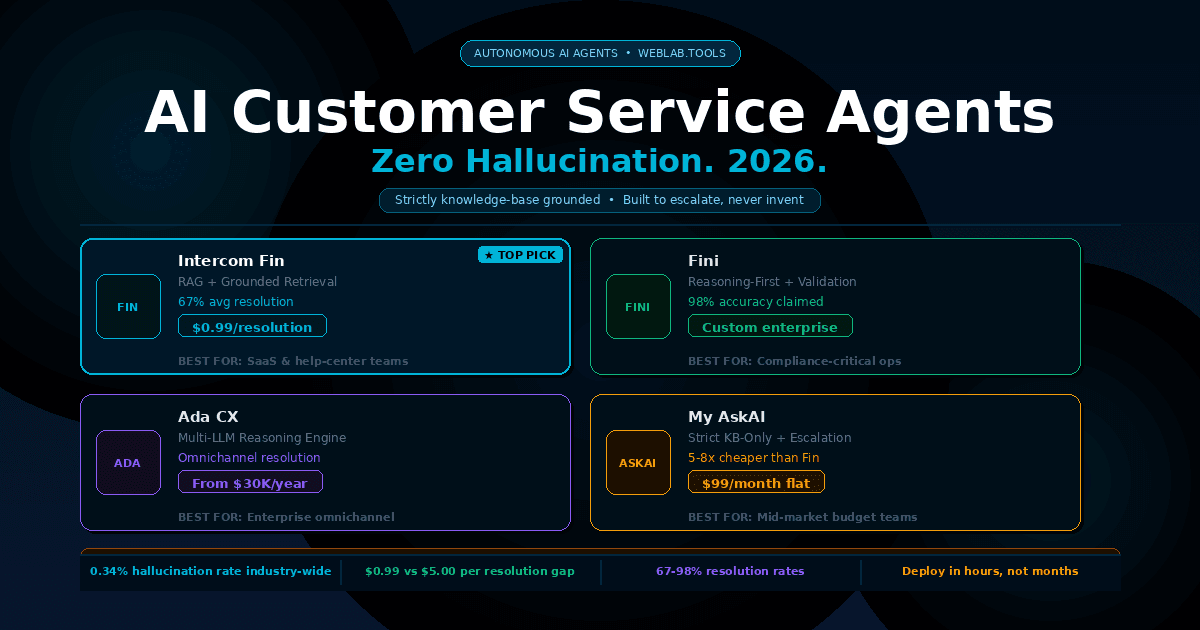
| Intercom Fin | RAG + grounded retrieval | $0.99/resolution | 67% avg (86% claimed) | SaaS, help-center-backed support |
| Fini | Reasoning-first + validation layer | Custom enterprise | 98% accuracy claimed | Enterprise, compliance-sensitive |
| Ada CX | Multi-LLM Reasoning Engine | ~$30K+/year | Published per client | Omnichannel enterprise |
| My AskAI | Strict KB-only + escalation | From $99/month | Varies by KB quality | Mid-market, budget-first |
Pricing as of May 2026 — confirm at each tool’s official pricing page before purchasing.
Why Sierra AI Is Not on This List
Sierra AI is the most frequently searched brand in this category and deserves a direct answer rather than a buried mention.
Sierra is genuinely impressive at enterprise scale. Founded by Bret Taylor and Clay Bavor, it reached $150M+ ARR with its first $50M quarter in early 2026. It serves 40% of the Fortune 50. Its architecture handles complex multi-step agentic workflows — processing returns, managing subscription changes, executing account-level decisions — with a depth that most competitors don’t match.
The reasons it’s not on a list of “zero hallucination tools for knowledge-base-restricted support” are specific:
It’s not a knowledge-base-restricted agent. Sierra is an agentic platform that takes real business actions across integrated systems. That’s powerful but it’s categorically different from a tool that strictly grounds responses in a defined knowledge base and escalates when uncertain. The hallucination risk profile is different when an agent can take consequential actions.
The pricing is prohibitive for most teams. Sierra’s outcome-based pricing lands at $2–$5 per resolved conversation, with year-one total costs frequently reaching $200K–$350K+, plus 3–7 months of deployment time. That’s an enterprise consulting engagement, not a support tool deployment.
Implementation dependency. Workflow changes typically require Sierra’s engineering team. Self-managed iteration after deployment is limited. For teams that want to own and update their AI agent configuration without vendor involvement, Sierra is a poor fit regardless of the budget.
If you’re evaluating Sierra: Intercom Fin at $0.99/resolution, Ada at roughly the same per-resolution rate but with more autonomous workflow depth, or a custom build for teams processing above 5,000–10,000 monthly interactions are the realistic alternatives at lower cost and faster deployment.
1. Intercom Fin — Best for SaaS Teams With an Established Help Center
Intercom Fin is the most widely deployed AI customer service agent in the SaaS segment and the clearest benchmark for knowledge-base-grounded support in 2026. The architecture combines RAG-based retrieval (answers draw exclusively from your connected knowledge sources — Intercom articles, external URLs, PDFs, Zendesk Help Center, Salesforce KB) with strict grounding enforcement that prevents the model from generating answers outside retrieved content.
When Fin doesn’t have a high-confidence answer, it escalates to a human agent — it doesn’t guess. That escalation discipline is the architectural behavior that matters most for hallucination prevention. A bot that says “I don’t know, let me connect you to someone who does” is categorically safer than a bot that invents an answer.
Fin’s published average resolution rate is 67% across all deployments, with enterprise teams on well-maintained knowledge bases reporting 80–86% resolution. The Fin Million Dollar Guarantee is worth noting — new enterprise customers are guaranteed a 65% resolution rate or Intercom pays $1M. That guarantee exists because the architecture is mature enough to support it.
The pricing model is the clearest in the category. At $0.99 per resolution, you pay only for conversations Fin resolves end-to-end — not for escalations, not for conversations it fails on. Add the Intercom seat cost (Essential at $29/seat/month) for human agent handling and the total cost of ownership is calculable before you sign anything. At 10,000 monthly resolutions, you’re paying approximately $9,900 in AI fees plus seat costs — a predictable number that scales linearly with performance.
What most Fin reviews miss: Fin operates inside the Intercom ecosystem. If you’re currently on Zendesk, Freshdesk, or HubSpot as your primary helpdesk, Fin works as an overlay — connecting via integration rather than replacing your stack. The quality of that integration varies by helpdesk. Teams fully committed to non-Intercom helpdesks should evaluate My AskAI as a cheaper Fin-equivalent that plugs into existing infrastructure more cleanly.
The honest limitation: Fin is cloud-only with no self-hosted option. For regulated industries where data must stay on-premises — healthcare, certain fintech categories, government — Fin is immediately disqualified. The knowledge base also requires maintenance discipline. Fin’s accuracy is directly proportional to the cleanliness of your help center content. Outdated articles, conflicting policies, and thin coverage are the primary cause of poor resolution rates in real deployments.
Pricing as of May 2026 — confirm at intercom.com/fin:
- Fin AI resolution: $0.99 per resolution (pay only when Fin resolves end-to-end)
- Intercom Essential seat: $29/seat/month (required for human agent handling)
- Intercom Advanced: $99/seat/month — adds advanced automation and reporting
- No setup fees, no implementation costs for help-center-backed deployments
- Live within under one hour for teams with an existing Intercom help center
Best for: SaaS companies, B2B teams, and digital businesses with an established help center and 1,000–100,000+ monthly support interactions. The best entry point for teams wanting transparent per-resolution pricing without multi-month enterprise onboarding.
Skip if: Your data cannot leave your infrastructure, your support operation is primarily voice-first, or you need deep agentic actions (processing refunds, managing subscriptions) rather than knowledge-base-grounded Q&A. Fin’s action capabilities are growing but less mature than Sierra or Ada for complex transactional workflows.
2. Fini — Best for Enterprise Compliance-Sensitive Support
Fini is a YC-backed AI agent platform built specifically for enterprise support teams where accuracy is a non-negotiable compliance requirement. The architectural difference from RAG-based tools is meaningful: Fini uses a reasoning-first approach rather than standard retrieval-augmented generation.
Standard RAG retrieves relevant content chunks and feeds them to the model for answer generation. Fini’s architecture adds a validation layer between generation and delivery — the model produces an answer, the system cross-references it against the source material, and only validates answers that trace cleanly back to a specific document or record. Answers that don’t pass the validation layer are escalated rather than delivered.
The result is a published accuracy rate of 98% across 2 million-plus production queries. That number is backed by enterprise case studies rather than demo conditions — Primary Arms reports a 98% question recognition rate and 84% full resolution rate. The Knowledge Atlas feature detects conflicts between knowledge sources at write-time rather than at answer-time — meaning contradictory articles are flagged before the AI ever sees them, not after a customer receives a conflicting response.
For compliance-sensitive industries — fintech, insurance, healthcare — this architecture matters significantly. Fini also holds comprehensive compliance certifications including SOC 2, HIPAA, and GDPR with zero data retention policies for LLM providers.
The honest limitation: Fini’s pricing is enterprise-tier and not publicly listed. Expect custom contracts with annual minimums. The deployment timeline is also longer than Intercom Fin’s “under one hour” benchmark — Fini’s onboarding is more thorough, which produces better accuracy outcomes but requires more initial investment. For teams that need to be live this week, Fini is not the right choice. For teams where a hallucinated answer has regulatory consequences, the investment is justified.
Pricing as of May 2026 — confirm directly at usefini.com:
- Custom enterprise pricing — contact Fini for a quote
- No public rate card
- Annual contracts standard
Best for: Enterprise support teams in regulated industries — fintech, insurance, healthcare, legal — where answer accuracy is a compliance requirement and a hallucinated policy response has real financial or regulatory consequences.
Skip if: Your budget is under $50K annually, you need to deploy in days, or your support volume doesn’t justify enterprise contract minimums. Intercom Fin at $0.99/resolution delivers comparable grounding for lower-stakes support contexts at a fraction of the cost.
3. Ada CX — Best for Omnichannel Autonomous Resolution
Ada is the most mature AI-native customer service platform in the autonomous resolution category — meaning it doesn’t just answer questions from a knowledge base but takes actions across integrated systems. Its multi-LLM Reasoning Engine selects the most appropriate model for each query type, reducing hallucination by routing simpler queries to smaller, more constrained models rather than defaulting every response to a large general-purpose LLM.
Ada’s constraint architecture is distinctive. Rather than allowing the model to access its full parametric memory, the Reasoning Engine is scoped at the deployment level — you define the knowledge sources, the permitted actions, and the escalation conditions. The model operates within those constraints, escalating when the query falls outside the defined scope rather than reasoning beyond it.
The compliance certifications are the most comprehensive in this category: SOC 2, HIPAA, GDPR, and AIUC-1 with zero data retention policies for LLM providers. For organizations with enterprise procurement processes that require formal compliance documentation, Ada’s certification stack is the most complete available.
What most Ada reviews miss: Ada does not natively ingest PDFs, past ticket history, or Notion-style knowledge bases without custom integration work. For organizations whose institutional knowledge lives in unstructured formats — past ticket threads, internal wikis, PDF policy documents — the knowledge ingestion process requires more engineering effort than Intercom Fin or My AskAI.
The honest limitation: Ada’s pricing starts at approximately $30,000/year with per-resolution rates of $1–$3.50 for AI-resolved interactions. Enterprise deals reach $100K–$300K+. For any team under 5,000 monthly support interactions, the cost-to-value math doesn’t work. Ada is built for and priced for organizations where a percentage-point improvement in resolution rate translates to meaningful cost reduction at volume.
Pricing as of May 2026 — confirm directly at ada.cx:
- Starting at approximately $30,000/year based on multiple independent sources
- Per-resolution: $1–$3.50 per AI-resolved conversation
- Enterprise deals: $100,000–$300,000+/year
- [Pricing unconfirmed from public sources — confirm directly with Ada before purchasing]
Best for: Enterprise organizations with 10,000+ monthly support interactions across multiple channels (chat, email, voice, SMS) who need omnichannel autonomous resolution with the strongest compliance certification stack in the category.
Skip if: Your budget is under $30,000 annually, your knowledge base is primarily in PDF or unstructured formats without engineering support, or your team doesn’t have the implementation capacity for a platform of this complexity.
4. My AskAI — Best Budget-First Alternative for Mid-Market Teams
My AskAI is the tool that Sierra AI alternatives articles consistently omit — which is a disservice to the teams it’s actually built for. It operates as an AI agent layer inside your existing helpdesk — Zendesk, Intercom, Freshdesk, HubSpot — without requiring you to rip out and replace your support infrastructure. Setup takes under 10 minutes. No engineering required.
The hallucination architecture is the strictest on this list in one specific way: My AskAI will not answer questions that fall outside your connected knowledge sources. It doesn’t try to reason its way to an adjacent answer. It doesn’t extrapolate. When it doesn’t know, it says so and routes to a human agent. That binary approach — answer from knowledge base, or escalate — is the most reliable hallucination prevention mechanism available, because it removes the model’s opportunity to hallucinate in the first place.
The knowledge ingestion is the most flexible on this list. Connect Notion, Google Drive, Confluence, Zendesk Help Center, Intercom Articles, PDFs, web URLs, or past ticket history. My AskAI builds its knowledge graph from wherever your institutional knowledge actually lives, not just from a formatted help center. For teams whose documentation is scattered across multiple tools, that flexibility removes a significant implementation barrier.
The comparison to Intercom Fin is direct and often relevant: My AskAI is marketed explicitly as a “direct swap for Intercom Fin” at 5–8x lower cost. At $99/month flat for the entry tier, a team handling 10,000 monthly AI interactions pays $99 versus approximately $9,900 for Fin at $0.99/resolution. That gap only closes if Fin’s resolution rate is significantly higher — and for knowledge-base-backed queries on well-maintained content, the resolution quality is comparable.
The honest limitation: My AskAI’s resolution rates are highly dependent on knowledge base quality and comprehensiveness. Tools with more sophisticated reasoning engines (Fini, Ada) perform better on edge cases, ambiguous queries, and multi-step reasoning. My AskAI performs best on well-defined, discrete support queries where the answer exists clearly in a knowledge article. For complex agentic workflows — processing refunds, account changes, subscription management — My AskAI is not the right tool.
Pricing as of May 2026 — confirm at myaskai.com/pricing:
- Starter: $99/month — unlimited AI responses, connects to existing helpdesk
- Business: Custom pricing for higher volumes and enterprise features
- No per-resolution fees on flat plans — predictable monthly cost
Best for: Mid-market SaaS companies, digital businesses, and teams currently evaluating Intercom Fin who want comparable knowledge-base grounding at a fraction of the per-resolution cost. Particularly strong for teams on Zendesk or Freshdesk who want AI resolution without switching helpdesks.
Skip if: Your support workflow requires complex agentic actions, your query volume is so high that the flat plan doesn’t cover it economically, or your organization requires the enterprise compliance certifications (HIPAA, SOC 2 Type II) that My AskAI’s entry tier doesn’t provide.
The Real Cost Comparison at Production Volume
The pricing model differences in this category produce dramatically different bills at scale. Here’s what each tool actually costs at 10,000 monthly resolved conversations:
- My AskAI: ~$99/month flat — effectively $0.01 per resolution
- Intercom Fin: $0.99 × 10,000 = $9,900/month plus seat costs
- Ada CX: $1–$3.50 × 10,000 = $10,000–$35,000/month (within enterprise contract)
- Sierra AI: $2–$5 × 10,000 = $20,000–$50,000/month (within enterprise contract)
- Fini: Custom — request quote
The per-resolution pricing advantage of My AskAI at low-to-moderate volume is significant. The trade-off is capability depth — Intercom Fin, Ada, and Fini offer meaningfully stronger resolution quality on ambiguous queries and agentic workflow execution that My AskAI doesn’t support.
The inflection point for most mid-market teams is around 1,000–3,000 monthly resolved conversations. Below that threshold, My AskAI’s flat pricing wins clearly. Above it, the per-resolution models start offering better ROI if their resolution rates and capability depth justify the cost.
For teams building the broader digital infrastructure that surrounds their customer support operation, see our Zendesk Alternatives for Startups guide on the full helpdesk stack these agents plug into. And if you’re automating the outbound side of your customer operations alongside inbound support, the AI Sales Agents for Small Business article covers the outbound automation layer.
FAQ
What is a zero-hallucination AI customer service agent?
A zero-hallucination AI customer service agent is one whose architecture prevents the model from generating answers outside verified knowledge sources. In practice, this means every response traces to a specific document or API record, processes with consequential outcomes run as code rather than LLM inference, and the agent escalates to a human when its confidence is below a defined threshold rather than fabricating an answer. No tool achieves literal zero hallucination in all conditions — the term refers to architectures that make hallucination structurally unlikely rather than merely statistically rare.
How is Intercom Fin different from Sierra AI?
They serve different use cases despite both being AI customer service agents. Intercom Fin is a knowledge-base-grounded support agent that answers questions from your help center and escalates when it can’t. Sierra AI is an agentic platform that takes real business actions across integrated systems — processing returns, managing subscriptions, executing multi-step workflows. Fin deploys in under an hour with no setup fees. Sierra typically requires 3–7 months and $200K–$350K+ in year-one costs. For teams that need knowledge-base Q&A with high accuracy and transparent pricing, Fin is the more appropriate tool at most budget levels.
What resolution rate should I expect from an AI customer service agent?
Realistic tier-1 deflection ranges from 35% to 75% depending on industry, ticket complexity, and knowledge base maturity. Intercom Fin publishes a 67% average resolution rate across all deployments, with mature implementations reaching 80–86%. Ada and Fini publish higher accuracy figures on enterprise deployments with well-maintained knowledge bases. Tools that publish suspiciously high resolution rates without production case studies — 95%+ is a red flag without verification — are typically measuring query recognition rather than full end-to-end resolution.
Is My AskAI a real alternative to Intercom Fin?
For knowledge-base-grounded Q&A on well-defined support queries, yes. My AskAI plugs into the same helpdesks Fin does — Zendesk, Intercom, Freshdesk, HubSpot — with comparable grounding architecture and escalation behavior at 5–8x lower cost on a per-resolution basis. Where it falls short is complex agentic workflows, edge case reasoning on ambiguous queries, and enterprise compliance certifications. For teams whose support volume is primarily discrete FAQ-style queries on maintained documentation, My AskAI delivers comparable accuracy at a fraction of the cost.
How do I prevent my AI customer service agent from hallucinating?
Four practices reduce hallucination risk in production. First, run a content freshness audit on your knowledge base before deployment — archive anything over 12 months old that hasn’t been explicitly reviewed. Second, enforce single-source attribution — resolve conflicting articles before connecting your knowledge base to the agent. Third, set conservative escalation thresholds at launch — a bot that escalates 40% of queries initially and learns its scope is safer than one tuned for high resolution rates from day one. Fourth, track hallucination rate as a first-class metric alongside CSAT and resolution time — not as an afterthought.

